
-
Online Office System
-
中文
Online Office System
中文
© 2022 All Rights Reserved.粤ICP备14051456号
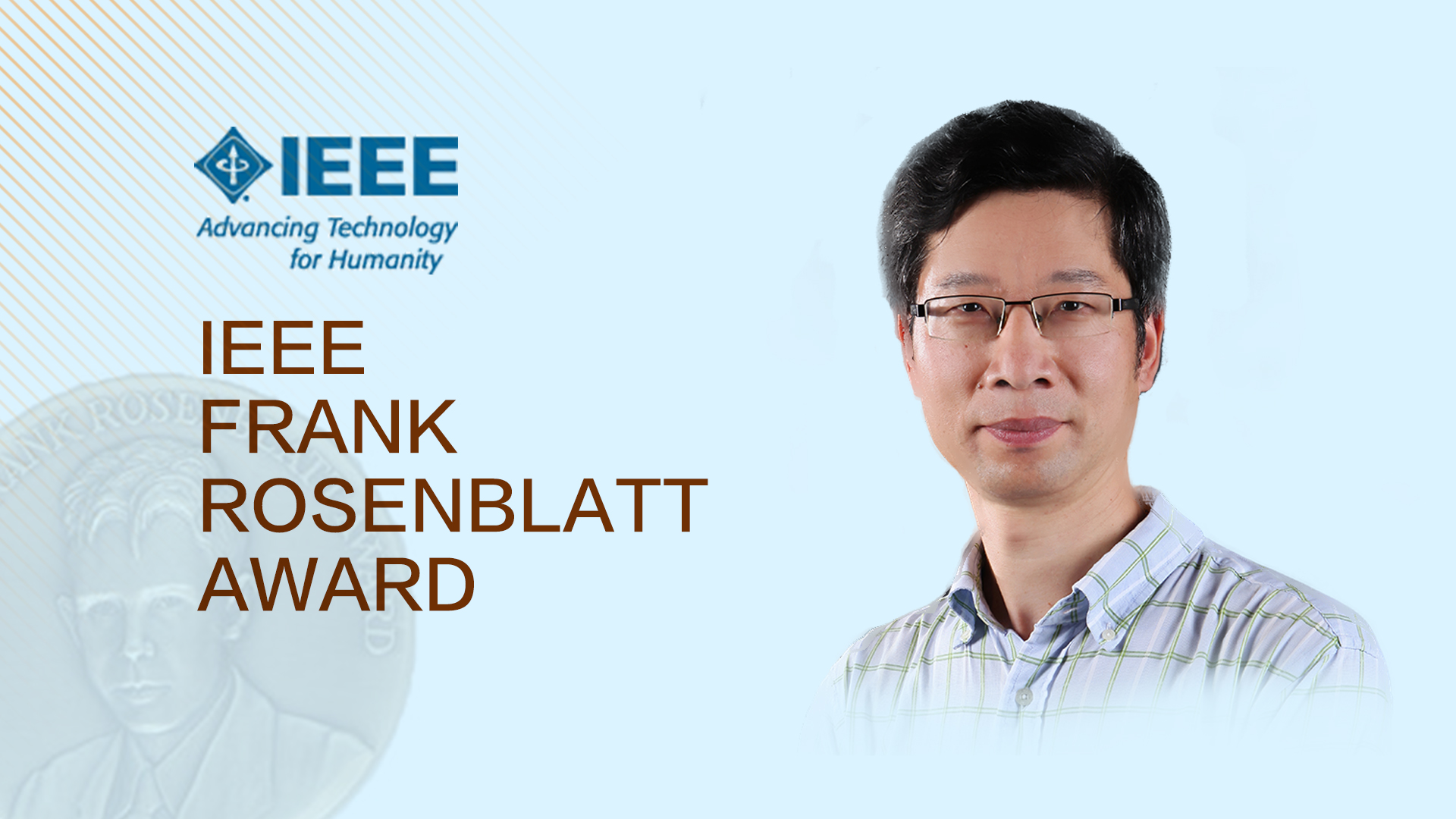
On June 15, Chair Professor Xin YAO from the Department of Computer Science and Engineering (CSE) at Southern University of Science and Technology (SUSTech) was awarded the Institute of Electrical and Electronics Engineers (IEEE) Frank Rosenblatt Award for 2020. Chair Professor Xin YAO is the first Chinese scholar to win this award.Xin Yao’s accomplishments in advancing evolutionary computation and machine learning are making it easier to solve complex optimization problems by impacting both the foundational and practical aspects of computational intelligence. His approaches to fast evolutionary programming have been applied to neural network structure learning, optimal routing, digital filter design, and design of new materials. His work on stochastic ranking has had a significant impact on solving constraint optimization problems in the areas of electrical, chemical, mechanical, and aeronautical engineering, biology, and economics.The IEEE Frank Rosenblatt Award is a Technical Field Award that was established in 2004. The award is presented for outstanding contributions to the advancement of the design, practice, techniques, or theory in biologically and linguistically motivated computational paradigms. These include neural networks, connectionist systems, evolutionary computation, fuzzy systems, and the hybrid intelligent systems in which these paradigms are contained.Chair Professor Xin YAO is a leading scholar in artificial intelligence. He is a Fellow of the American Institute of Electrical and Electronics Engineers and a former chairman of the IEEE Computational Intelligence Society. From 2003 to 2008, he served as editor in chief of IEEE Transactions on Evolutionary Computation. To date, he has published more than 800 papers in high-impact academic journals and at leading conferences. His papers have been cited more than 49,000 times with an H-index of 99. He has previously won the IEEE Donald G. Fink Paper Award and the IEEE Transactions on Neural Networks Outstanding Paper Award.
2020-09-11

Department of Computer Science and Engineering (CSE) Chair Professor Georgios Theodoropoulos has been elected Fellow of the World Academy of Art and Science (WAAS).Professor Theodoropoulos joined Southern University of Science and Technology (SUSTech) in 2017 from Durham University. He was the inaugural Executive Director of the Institute of Advanced Research Computing (iARC).His work spans more than 25 years in both academia and industry. He has been a senior scientist with IBM Research. He has held senior faculty positions in world-class universities, including the University of Birmingham, Trinity College Dublin, and Nanyang Technological University.His interests and contributions are in modeling and distributed simulation, complexity and multi-agent systems, info-symbiotic systems, high-performance computer architectures, and data-intensive systems. His current efforts focus on large scale data-driven simulation infrastructures for prescriptive system-of-systems analytics, targeting global challenges as defined by the UN SDGs.WAAS was founded in 1960 on the initiative of Albert Einstein and Robert Oppenheimer. Nobel laureate Bertrand Russell, Joseph Needham (founder of UNESCO), and Brock Chisholm (inaugural Director-General of WHO) are amongst its prominent charter members. Today the Academy is composed of about 700 Fellows from 80 countries, including scientists, leading artists, politicians, statesmen, heads of research institutes and international organizations, Nobel Prize winners, and business leaders. WAAS is a member of the Interacademy Partnership, the global network of science, engineering & medical academies.An election into WAAS is considered one of the highest honors that can be accorded to a scientist. Election of a Fellow is based on distinction and leadership in their profession, interdisciplinary accomplishments, a record of public service, and a global perspective. To be a Fellow of the Academy is to be a member of the global civil society, concerned for the welfare of the increasingly interconnected global civilization with a demonstrated commitment to addressing issues of global importance.
2020-09-09

Research conducted at Southern University of Science and Technology has extended our understanding of computational intelligence and its applications. The scholars have published significant research in top journals in diverse fields, representing the interdisciplinary nature of their findings.In recent months, Assistant Professor Ran Cheng (Computer Science and Engineering) has led his research team, known as the Evolving Machine Intelligence (EMI) Group, to publish their research outcomes in high-impact academic journals. IEEE Transactions on Evolutionary Computation (IF = 11.169), IEEE Transactions on Cybernetics (IF = 11.079), and the Journal of Hematology & Oncology (IF = 11.059) are among the journals that have published their findings.The first paper published in IEEE Transactions on Evolutionary Computation was titled, “Evolutionary Large-Scale Multiobjective Optimization for Ratio Error Estimation of Voltage Transformers.” This paper sought to examine new solutions in modern power delivery systems.For modern power lines, substations have tended to use capacitive voltage transformers (CVT) to provide a voltage signal to the electricity meter. Any measurement errors directly affect the accuracy of the measurement of electrical energy.110kV substations and above have been using CVT for many years, but error abnormalities increase after long-term use. CVTs cannot be recalibrated regularly due to the high economic cost, as they must be de-energized and assessed against standard CVTs manually. Recent studies on the subject had suggested online evaluation of CVT by pre-calibration. However, this technique would not solve the de-energizing problem.The research team took a different approach and developed a time-varying ratio error estimation (TREE) problem, and built it into a large-scale multi-objective optimization problem. They applied multiple objectives and inequality constraints, informed by mathematical and physical rules from the electrical grid. Their TREE problem sets from different substations were then combined into a suite of benchmark tests.Their solution turned an expensive estimation task into a cheaper optimization problem that promotes real-world benchmark tests that incorporate complex variables and correlations. It is the first time that computational intelligence optimization was used to solve the problem of evaluating the measurement error of physical equipment. Electricity providers can now realize the online evaluation of the CVT individual measurement error.The devices and platforms developed by the project have been deployed to nearly 300 substations in provinces such as Shanxi, Shandong, Zhejiang, Hunan, and Hubei. At least 16 CVTs have been found to have abnormal errors, all of which have been validated by power de-energizing methods.SUSTech Research Assistant Professor Cheng He was the first author of the paper. Assistant Professor Cheng Ran is the correspondent author, with SUSTech as the correspondent unit. Additional contributions came from Huazhong University of Science and Technology, and Anhui University.Fig. 1 The application of computational intelligence methods in ratio error estimation of CVTs The paper published in the Journal of Hematology & Oncology was titled “Constructing an automatic diagnosis and severity-classification model for acromegaly using facial photographs by deep learning.” Acromegaly is a rare condition that affects about 60 people per million. It is thought to be caused by the continuous excessive secretion of growth hormone (GH) into the pituitary gland.Due to the vague symptoms and slow progression, it is challenging to diagnose the disease in its early stages. As a result, severe complications such as cardiovascular disease are delayed, requiring more expensive treatment. Improved automatic and efficient screening methods must be found to diagnose the disease quickly and accurately.The research team developed a deep learning method for the automatic diagnosis and severity classification of acromegaly by learning facial features. This method can help people to carry out self-screening conveniently, thereby achieving early diagnosis and treatment of acromegaly. It is the first automated method that can classify the severity of acromegaly with an accuracy of more than 89% for each classification. This deep learning method has laid the foundation for its further implementation and application.SUSTech Assistant Professor Cheng Ran was a co-corresponding author, with Peking Union Medical College Hospital (Chinese Academy of Medical Sciences) Dr. Yanguo Kong and Dr. Xiangyi Kong. Additional contributions came from Tsinghua University, Shenzhen University, and the University of Cambridge.Fig. 2 The accuracy of the proposed deep learning method in severity classificationThe second paper published in IEEE Transactions on Evolutionary Computation was entitled, “Benchmarks for Continuous Dynamic Optimization: Survey and Generalized Test Suite.” The research team was assessing new optimization techniques for complex and dynamic situations.Logistics scheduling and flighting planning are highly flexible, changing by the minute or faster. The design schemes can vary rapidly and are challenging for existing optimization methods to solve. Controllable test suites are needed to reflect the complexities of dynamic optimization problems that are faced in the real world.The research team devised a suite of benchmark tests that generate continuous dynamic optimization problems. It reviewed the existing set of tests before proposing a highly configurable suite of benchmark tests. Each variable within the benchmark tests is highly dynamic, allowing for better solutions for the various problems.Postdoctoral researcher Danial Yazdani is the first author, and Assistant Professor Cheng Ran is the corresponding author. Additional contributions came from the University of Birmingham, the University of Warwick and Liverpool John Moores University. SUSTech is the corresponding unit.Fig. 3 Examples of controllable complex dynamic optimization problems with different variable interactionsThe final paper was published in IEEE Transactions on Cybernetics and titled, “Evolutionary Multiobjective Optimization Driven by Generative Adversarial Networks (GANs).” The research team was looking to improve the methods that computational intelligence use to learn from the problems they are tasked at solving.As computational intelligence is applied to a broader range of challenges, that intelligence needs to improve. Researchers have incorporated machine learning models to enhance computational intelligence, which is highly dependent on the training of the adopted model. However, these traditional machine learning methods require large amounts of training data and shown limited capability in real-world applications.The research team published an evolutionary multi-objective algorithm that used Generative Adversarial Network (GAN) instead of the traditional cross mutation method. Their approach would teach potential distribution patterns from existing data. It would allow for problems to be learned solved efficiently from limited training data. It also opens up a new path for integrating computational intelligence and deep learning.Fig. 4 The general framework of the adopted generative adversarial model for offspring generation in computational intelligence methodResearch Assistant Professor Cheng He was the first author, and Assistant Professor Cheng Ran was the corresponding author. Additional contributions came from the City University of Hong Kong and the University of Surrey. SUSTech was the corresponding unit.
2020-08-10

Chair Professor Ishibuchi HISAO from the Department of Computer Science and Engineering (CSE) at Southern University of Science and Technology (SUSTech) has led his research team to considerable success through the quality of their research papers. Their papers have been acknowledged at international conferences on evolutionary computing across 2020, with four being shortlisted on the Best Paper list, and one winning the Best Paper Award.His team won the Best Paper Award at the 2020 ACM International Conference on Genetic and Evolutionary Computing (GECCO2020). Their paper was titled, “Another Difficulty of Inverted Triangular Pareto Fronts for Decomposition-Based Multi-Objective Algorithms.” Their paper studied the influence of user-defined parameters on decomposition-based multi-objective optimization algorithms. The researchers proposed a method of generating a weighted vector. Their weighted vector would improve the performance of their algorithm on the inverted triangle frontier problem.His students were shortlisted for Best Paper and Best Student Paper at the IEEE Congress on Evolutionary Computation (IEEE CEC2020). The paper that was nominated for Best Paper was titled “Riesz s-energy-based Reference Sets for Multi-Objective Optimization.” It proposed a method for using s-energy to generate uniformly distributed point sets in Pareto frontiers. Their main contribution was to make a more reliable evolutionary optimization algorithm. It was achieved by providing the uniformly distributed reference points.The nomination for Best Student Paper was titled “A Decomposition-based Large-scale Multi-modal Multi-objective Optimization Algorithm.” It hypothesized a method designed for large-scale, multi-objective optimization based on traditional multi-objective optimization algorithms (MOEA/D). Their new algorithm that works for both multi-model and multi-objective optimization problems achieved excellent results in many different mainstream testing environments.Parallel Problem Solving from Nature 2020 (PPSN 2020) will take place later this year. The team has had their paper, “Proposal of a Realistic Many-Objective Test Suite,” nominated for best paper. It proposes a set of new test problems based on the coefficient matrix to solve the real problems that cannot be solved by the current set of multi-objective test problems. The research team pointed out that the use of a coefficient matrix affects the difficulty of test problems. Thus, a new series of test questions need to be designed.Chair Professor Ishibuchi HISAO is also the corresponding author of a paper that has been shortlisted as Best Student Paper for the IEEE International Conference on Fuzzy Systems (FUZZ-IEEE 2020). It proposes an evolutionary multi-objective optimization method to find multiple non-dominant fuzzy rule classifiers from both classification accuracy and classifier complexity.
2020-07-30

On March 14, the Department of Computer Science and Engineering at Southern University of Science and Technology (SUSTech) held its undergraduate innovational laboratory course and postgraduate graduation thesis exhibition. It was organized by the SUSTech Intelligent Transportation Center and the SUSTech Intelligent and Virtual Reality Creator Service Platform.The poster session provided students an opportunity to show their research skills, and improve their academic communication and language expression skills. Students could also learn more comprehensive skills to solve real science and engineering problems in order to enhance their sense of social responsibility.After two hours of student poster display, a total of one first prize, two second prizes and four third prizes were selected among 24 undergraduate course projects. For the midterm postgraduate graduation papers, one first prize, two second prizes, and four third prizes were selected also selected from among 23 papers.
2019-08-21
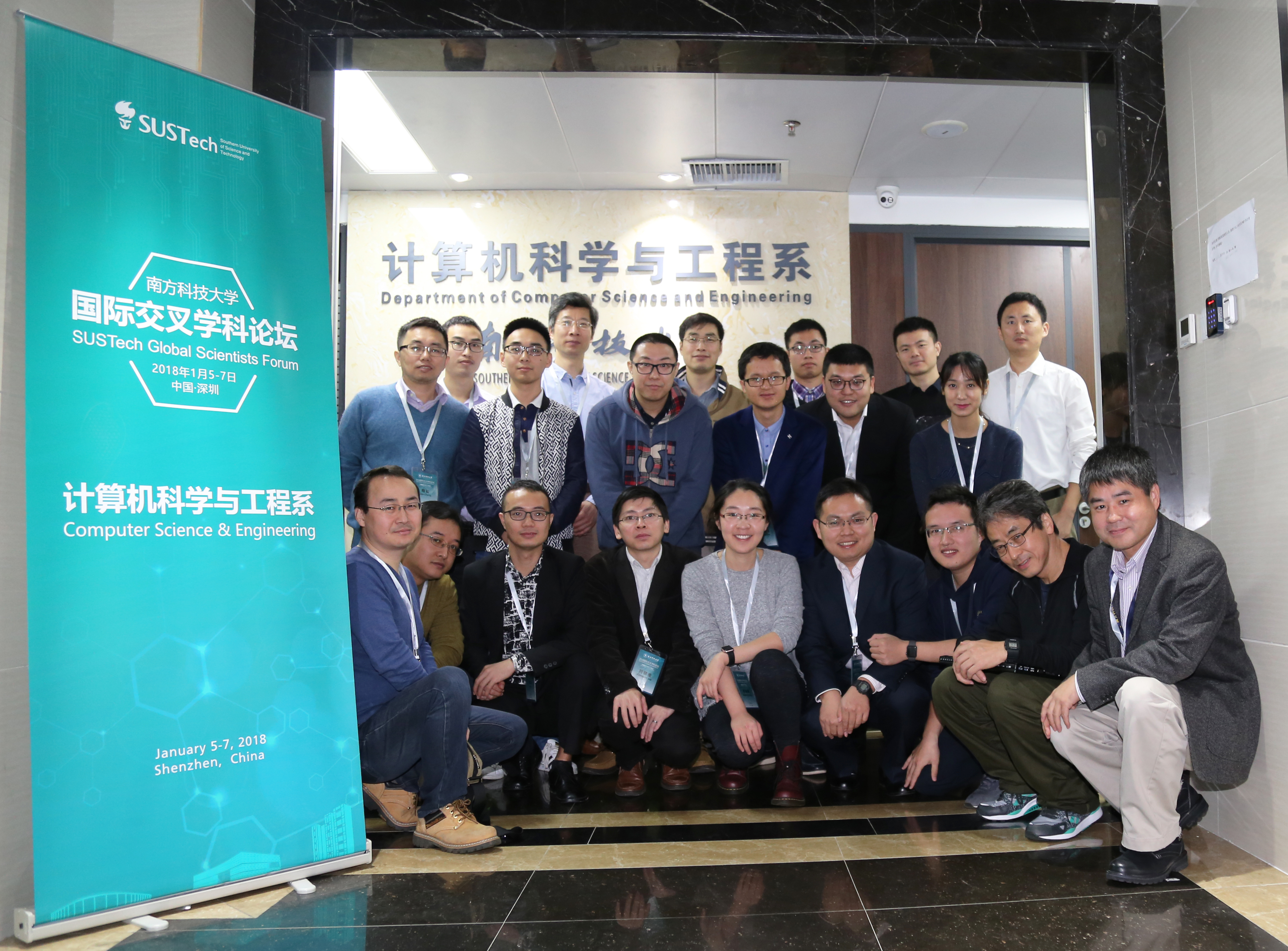
On January 6, the 2018 SUSTech Global Scientists Forum of Southern University of Science and Technology opened grandly in Shenzhen Kylin Villa. The forum attracted more than 220 outstanding experts and scholars from home as well as abroad. This forum aims to provide a platform for brainstorm and academic exchanges among experts and scholars, to promote multi-disciplinary cross-convergence and academic innovation. Opening ceremony Group photoIn the afternoon, experts and scholars came to various departments to participate in the sub-forums and conducted a two-day academic exchange with professors from different departments. The sub-forum of Computer Science and Engineering Department was held at Nanshan i-Park, talents from Imperial College London, Queen Mary University of London, Nanyang Technological University, University of Technology Sydney, The University of Queensland, Monash University, University of Florida, The Hong Kong Polytechnic University, University of Melbourne, National University of Defense Technology, Sichuan University, excelling in the computer field of well-known universities domestically and abroad, as well as outstanding talents from top international IT companies such as Apple Inc. and NEC, were invited to participate in the forum and gathered together with professors from CSE Department to discuss the latest research. Professor Yao Xin, Director of the Department of Computer Science, presided over the sub-forum. Dr. Kezhi Li from Imperial College London gave an academic report Participants for academic report Sub-forum site Tea breakIn the sub-forum, twenty-one guests made speeches in the field of computer frontiers research in artificial intelligence, machine learning, data science, computational vision and smart medical. The speeches were entitled “Noisy Black - Box Optimization: Resampling Methods and Portfolio”, “Similarity regularized sparse group lasso for cup to discratio”, "Towards Efficient Analytic Query Processing in Main-Memory Column-Stores", "Bridging the Gap between Database and Multimedia for Surveillance Video Search" and "Angle - Closure Glaucoma Assessment in Anterior Segment OCT" They have made academic reports, and in-depth discussions with the department professors from our department.The Department of Computers has built an efficient and cutting-edge academic exchange platform through the Forum. At the same time, it has successfully recruited talents from the computer field through the forum, which has enriched the computer department wing.
2018-10-10