
-
Online Office System
-
中文
Online Office System
中文
© 2022 All Rights Reserved.粤ICP备14051456号

January 2022Shenzhen, P. R. China1. IntroductionThe Global Computer Scientist Forum hosted by the Department of Computer Science and Engineering of Southern University of Science and Technology (SUSTech) aims to provide a common platform for computer scientists to present their best research outcomes, exchange their research ideas and discuss their ambition of contributing to the development of a world-class computer science department at SUSTech. Through this Forum, we wish to select and recruit outstanding researchers who share our vision and ambition to become a world-class computer science department. 2. Forum Schedule 1) Onsite Forum (will be held in the campus of SUSTech, and is for scholars currently staying in the mainland of China)Registration Date: January 7, 2022Dates of the Forum: January 8-9, 2022 2) Online Forum (will be held through an online conference platform, and is for scholars currently staying abroad)Dates of the Forum: January 15-16, 20223. Recruiting Categories • Senior Faculty (Chair Professor / Professor)• Young Talent (Associate / Assistant professor) 4. Application Materials and Methods 1) Application materials a. Resumeb. Research Statementc. Teaching Statement 2) Application due date: December 15, 2021 3) How to apply Please submit all your application materials to the mailbox of Department of Computer Science and Engineering (liuj6@sustech.edu.cn), with the subject line “Global Computer Scientist Forum - intended position” for evaluation. We will evaluate your application and send out invitations as soon as possible. Please send materials at your earliest convenience since the number of places at the Forum is limited. Successful applicants will receive the invitation email by December 20, 2021. 5. Travel and Accommodation1) Free accommodation and lodging on 01/07/2022-01/09/2022 will be provided to all invitees;2) Travels: All invited participants need to purchase their own tickets (high-speed train/second class, flight/economy class). We will provide travel reimbursement for the actual cost of tickets between 01/07/2022-01/10/2022 (maximum CNY 6,000 per person). 6. Contact InformationMs. Jing Liu,Tel: +86-755-88015125,Email: liuj6@sustech.edu.cn;※ The consultation email will be strictly confidential and will not be disclosed. 7. Qualifications and Benefits Related to Recruitment Senior Faculty (Chair Professor / Professor)1)Basic Requirements Candidate of national-level talent programs,tenured professor or associate professor of overseas well-known universities or research institutions, leading talent with internationally recognized achievements. 2)What We Will SupportResearch startup funds:will be discuss case by case, but highly generous.Additional support: At least 1 PhD student per year fully paid by the university and unlimited numbers of post-doctoral fellows partially subsidized by the university. Additional research assistant professors (RAPs), research scholars and research assistants hired by the faculty member her/himself. 3)Remuneration Salary: Globally competitive salary (one of the best in the sector); Preferential policy of individual income tax, income tax of qualified high-level talents will be compensated by local government to a maximum of 15% for qualified candidates.Insurances: Shenzhen’s highest level of retirement insurance, medical insurance, unemployment insurance, industrial injury insurance, maternity insurance and housing provident funds. Special high-level health insurance is negotiable.Subsidy: The university will assist in applying for the corresponding talent programs according to the national, provincial and municipal talent policies. Successful personnel will receive the relevant program funding / reward. 4)Benefits Housing: Temporary on-campus apartments provided or subsidies to support off-campus rental housing.Other benefits: Permanent residence or residence visa service for scholars and family (spouse and children) ; Service of children’s education in SUSTech affiliated preschool, primary school and middle school. Young Talent (Associate / Assistant professor)1)Basic RequirementsDoctoral degree obtained from internationally renowned universities and institutes; or Ph.D. degrees from Chinese universities and more than 36 months of overseas work experience, with a full-time teaching or research position in leading overseas universities or research institutes. Especially excellent talents are not subject to the above conditions. 2)What We Will SupportResearch startup funds:At least CNY 4 million in research funding is provided by local government and the university within 5 years.Additional support: At least 1 PhD student per year fully paid by the university and unlimited numbers of post-doctoral fellows partially subsidized by the university. Additional research assistant professors (RAPs), research scholars and research assistants hired by the faculty member her/himself. 3)RemunerationSalary: Globally competitive salary (one of the best in the sector); Preferential policy of individual income tax, income tax of qualified high-level talents will be compensated by local government to a maximum of 15% for qualified candidates.Insurances: Shenzhen’s highest level of retirement insurance, medical insurance, unemployment insurance, industrial injury insurance, maternity insurance and housing provident funds. Special high-level health insurance is negotiable.Subsidy: The university will assist in applying for the corresponding talent programs according to the national, provincial and municipal talent policies. Successful personnel will receive the relevant program funding / reward. 4)Benefits Housing: Temporary on-campus apartments provided or subsidies to support off-campus rental housing.Other benefits: Permanent residence or resident visa service for scholars and family (spouse and children); Service of children’s education in SUSTech affiliated preschool, primary school and middle school. CSE @ SUSTechEstablished in 2016, the Department of Computer Science and Engineering (CSE) is one of the youngest departments in SUSTech. Currently, there are 58 full-time faculty members, including 29 tenured/tenure-track professors (5 chair professors, 4 full professors, 10 associate professors and 10 assistant professors). All faculty members hold doctoral degrees and have research and/or teaching experiences in world-renowned universities. Among them are 3 IEEE fellows and 9 talents of national programs. Our faculty members have won prestigious international awards every year since 2016.The CSE department offers two undergraduate majors: Computer Science and Technology, Intelligent Science and Technology. Currently, there are 793 students in total, including 486 undergraduate students and 307 graduate students (104 PhD students and 112 master’s students). By November 2021, the department has published 1116 papers, and secured 120 external grants of over 230 million RMB.In the future, the CSE department will continue to expand its faculty with a target size of 55 tenured/tenure-track professors. The single most important priority in our recruitment is the quality of candidates, not their research areas. We sincerely welcome outstanding researchers from all over the world to join us!Website: http://cse.sustech.edu.cn/en/
2021-11-29

On December 31, AI-driven Application of Comprehensive Prevention and Control of Infectious Disease Risk Experiment was launched by Southern University of Science and Technology, Shenzhen Center for Disease Control and Prevention (CDC), and Shenzhen SmartCity Technologies Co., Ltd (Shenzhen SmartCity) in SUSTech Convention Center.Ang LIU, Deputy Secretary-General of Shenzhen Municipal Government, Bing WU, Deputy Director of Shenzhen Municipal Health Commission, Qikun XUE, SUSTech President, Junjie XIA, Director of CDC, and Xiquan XU, Chairman of Shenzhen SmartCity) attended the launching ceremony.The project aims to carry out simulation results on infectious disease transmission based on large-scale volunteer interaction experiments and explore a comprehensive solution for accurate prevention and control of infectious diseases. It is designed to prevent and control infectious diseases in real-time with mobile phone and AI technology.President XUE introduced the background of the cooperation and the features of the project. He said that SUSTech, in response to the call of the government, strengthens cooperation with industry to advance the research on the contagious disease, in which way the University can create an emergency-response plan for the future.Junjie XIA said that the research would help improve the speed and accuracy on the epidemic detection, which is of great significance to the control of infectious disease. The AI-based project will help create a more scientific algorithm model, making epidemic control more cost-effective and efficient.Xiquan YU said that the tripartite cooperation would give full play to their respective advantages in resources and technology and effectively promote the research on comprehensive prevention and control of the urban risk of infectious diseases. Shenzhen SmartCity will actively connect the government, universities, and all sectors of society, further promote industry-university-research cooperation, and contribute to the efficient and accurate implementation of government policies.A mobile app and a simulation platform of infectious disease transmission were among the comprehensive solution. The app can help users get the risk of surrounding epidemic or major infectious diseases in real-time by perceiving users’ contact with others as well as utilizing city’s meta data. Based on the data collected by the app, the platform can realize detailed modeling of the epidemic, virus transmission and infected population by integrating, processing, and analyzing the multi-modal human traffic big data, combined with AI algorithm. The platform outputs the relevant visual results of prediction and simulation to realize the quantitative evaluation of the implementation effect of different epidemic prevention measures, which can provide references for policy-makers in disease control departments.
2021-02-19
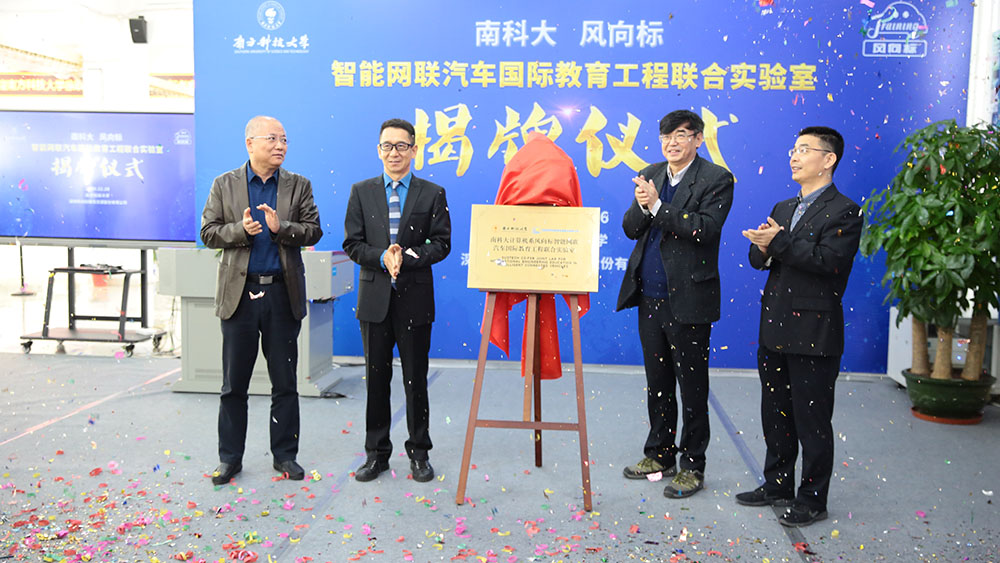
Recently, the unveiling ceremony of the SUSTech CS-FXB Joint Lab for International Engineering Education in Intelligent Connected Vehicles was held in Shenzhen Fengxiangbiao Education Co., LTD (FXB).FXB Chairman Yubiao WANG said that FXB, as an experienced player in the field of automobile education, while closely following the development trend of Intelligent Connected Vehicles and the national strategies, hopes to use the platform of the joint laboratory to contract with top teams at home and abroad, integrate the advantages of both sides, and upgrade automobile education resources and courses to the world-class level.Zhenghe XU, Dean of the College of Engineering expected that through the cooperation of joint laboratory, the two sides can further develop higher education teaching products, empower the cultivation of higher education skilled talents, and jointly introduce education products into the international market for a win-win result.Qi HAO, Deputy Head of the Department of Computer Science and Engineering reported on the construction and work plan of the joint laboratory. He expressed his hope that it upgrades into provincial, national, and even world-class level laboratory in the future, and promotes the development of intelligent connected education.Then, SUSTech faculty members visited the FXB exhibition hall. FXB staff introduced some projects, including wind vane software, smart education, new energy, intelligent networking, miniaturization, and other projects. After the exhibition, the two sides held a meeting to discuss the follow-up work and future R & D plan of the joint laboratory.
2021-02-19

Exclusive Interview with Dr. Xin YAO (Director of Guangdong Provincial Key Laboratory of Brain-inspired Intelligent Computation)One concept of Artificial intelligence (AI) is to let machines think like humans and mimic their actions. Brain-inspired intelligent computation is the grand challenge for achieving Human-level Artificial Intelligence.The international major AI powers are working hard on winning the race, especially in brain-inspired intelligent computation research.As a research-intensive university in China, SUSTech has started to explore AI through the Department of Computer Science and Engineering (CSE). Since 2017, the SUSTech Artificial Intelligence Institute (SAINT), Shenzhen Key Laboratory of Computational Intelligence, and Guangdong University Key Laboratory of Evolutionary Intelligence Systems have been set up.“Humans love to reflect and study the past as a way of trying to see the future,” said Dr. Xin YAO, SUSTech Chair Professor and CSE Founding Head. He believes that Artificial intelligence (AI) is an essential driver for the Fourth Industrial Revolution. To further advance the AI technology, scientists will ride on the growing computing power, algorithmic innovation, and data to push the fundamental research and technology development to the next higher level.In January 2020, a Key Laboratory led by Dr. Xin YAO was approved, approved, and funded by the Guangdong provincial government. The official name is the Guangdong Provincial Key Laboratory of Brain-inspired Intelligent Computation (the Key Laboratory).The Key Laboratory engages in fundamental research, technology development, and knowledge transfers in the broad field of evolutionary intelligent systems. It aims to make breakthroughs in AI technology, which is currently very weak in self-learning, self-evolving, and self-organization. It will explore cutting-edge research directions in swarm intelligence, the evolutionary intelligence, and trustworthy intelligent systems.The Key Laboratory is conscious of the development across the Greater Bay Area and its industrial transformation. It aims at developing a world-class brain-inspired intelligent computing industry-university collaboration platform to link academia with industry. It will promote the development of smart industries across the Greater Bay Area.Progress in AI Research at SUSTechThe main research directions of the Key Laboratory include the self-adaption and self-evolution theories and methods of intelligent systems, trustworthiness theories and methods of evolutionary intelligent systems, and the development of the vital technologies of green evolutionary intelligence systems.The Key Laboratory focuses on the prospective fundamental and applied research in AI by following approaches from closed to open systems, from cognition to decision-making, and from simple to complex systems. It aims to align its research directions to the country’s key & core technology needs and demands.By building a world-class innovation platform of brain-inspired intelligent computation, the Key Laboratory aims to drive industrial upgrading and facilitate smart industries in the Guangdong-Hong Kong-Macao Greater Bay Area through tight collaborations among universities and industry, knowledge transfer, and skills training.The Key Laboratory is providing a general-purpose intelligent computing platform for related industries. It will provide fundamental intelligent computing cloud platforms for industries and build industry-university joint laboratories. It will also carry out application-driven research projects while conducting IP transfers to strengthen university-industry cooperation. The current collaboration with industry led by the Key Laboratory professors includes strategic partnerships with and investment from major companies in the transportation, telecommunications, and automotive industries. Such collaborations have provided an excellent mechanism for providing industrial services and incubating potential start-ups.The Key Laboratory has shown significant promise through its research outcomes. Experts and scholars from the Key Laboratory have published papers in high-impact academic journals and conferences. They have won major international awards, including personal research achievement awards and outstanding paper awards, in recent years. For example, Chair Professor Hisao ISHIBUCHI, as a Key Laboratory Deputy Director, received the 2020 IEEE Transactions on Evolutionary Computation Outstanding Paper Award. His papers were shortlisted for Best Paper Awards at all three major international conferences on evolutionary computation, i.e., the 2020 IEEE Congress on Evolutionary Computation (CEC2020), 2020 Genetic and Evolutionary Computation Conference (GECCO 2020), and the Sixteenth International Conference on Parallel Problem Solving from Nature (PPSN XVI). One of those papers won the Best Paper Award at GECCO 2020. Assistant Professor Ran CHENG and his team have made further breakthroughs. As a leading researcher of the Key Laboratory, he and his team have made significant progress in computational intelligence and its applications. They have published a series of papers in high-impact academic journals. The proposed algorithms have been successfully applied to fault diagnosis of capacitor voltage transformer (CVT), grading diagnosis, and treatment of acromegaly. Dr. Xin YAO was awarded the prestigious IEEE Frank Rosenblatt Award for 2020.Strengthening the AI Research PipelineTo build a world-class Key Laboratory, world-leading researchers are the single most important driver. Dr. Xin YAO has spent much of his time and energy on attracting world-class talents to the Key Laboratory and SUSTech, an effort he has been making since he joined SUSTech in 2016 to set up the Department of Computer Science and Engineering (CSE).The Key Laboratory is currently led by three IEEE fellows and a group of young but experienced researchers in brain-inspired intelligent computation. The Key Laboratory consists of several research groups in different directions. Each of the groups is under one leading scientist. Dr. Xin YAO is a highly respected scholar in computational intelligence. He has taken the lead in the research of evolutionary neural networks. He is also one of the first researchers to study the computational complexity of intelligent optimization algorithms. Dr. Hisao ISHIBUCHI is an internationally-renowned scholar in computational intelligence and has created the research field of “multi-objective memetic algorithm.” He was the first scholar to put forward the design method of a multi-target fuzzy rule recognizer. Dr. Yuhui SHI has studied swarm intelligence for a long time. He is one of the founders of particle swarm optimization and the founder of the brainstorming optimization algorithm. Dr. Ke TANG has long been engaged in basic and applied research in artificial intelligence, intelligent optimization, and big data analytics. His research achievements in the integration of intelligent optimization algorithms have won the second prize of the Natural Science Award of the Ministry of Education. He has been recognized internationally as the sole winner (in that year) of the IEEE Computational Intelligence Society Outstanding Early Career Award and a Royal Society Newton Advanced Fellowship.Nurturing Tomorrow’s AI ScientistsDr. YAO and his team are also committed to undergraduate education as part of the broader talent pipeline. Its interdisciplinary training system has a global outlook and combines with its integrated industry-university research collaboration platforms. The Key Laboratory works closely with its industry partners across Guangdong Province and the Greater Bay Area in conducting high-level research of global impact.“Nurturing tomorrow’s AI scientists is one of our goals,” said Dr. YAO. The Key Laboratory will work within SUSTech to build brain-inspired intelligent computing-related undergraduate majors, including intelligent science and technology, artificial intelligence, and big data. “Our newly designed curriculum, combined with the cutting-edge research, is to meet the needs of industrial development in Guangdong province and China,”said him.The Key Laboratory aims to attract postgraduate students to participate in its research projects. It seeks to develop students’ understanding of industry-university research collaboration and the needs of enterprises to provide training mechanisms. Doctoral students will benefit from a talent training system that fosters well-rounded talent with a global vision, a robust understanding of AI, and familiarity of the AI industry. There are currently over 200 Ph.D. and MSc students at the Department of Computer Science and Engineering, which integrates tightly with the Key Laboratory.The students are reaping outstanding research infrastructure and renowned researchers in the Key Laboratory and the Department of CSE. It is now common for undergraduate students, let along with postgraduate students, to publish fully refereed papers at international academic conferences. Our MSc students have already started winning international grants, not just publishing papers.As far as Xin YAO is concerned, the Key Laboratory has enormous potential to support SUSTech in its quest to become a world-class research university. The Key Laboratory is striving to become a world-class brain-inspired intelligent computing research center. It aims to become a national hub for AI to build commercial applications of global standards. The Key Laboratory will provide the Greater Bay Area with much-needed skills and highly trained researchers and engineers and promote regional economic progress. The industry transforms itself by riding on the next generation of AI technologies.
2020-10-12

Understanding how people move across cities is a vital challenge for urban planners and policymakers across the world. Intelligent transformation systems have been implemented to try and plan transportation systems for population growth and other demographic changes. However, there are numerous issues with these systems.Recently, Assistant Professor James J.Q. Yu (Computer Science and Engineering) led his research group to make a series of research progress in the field of intelligent transportation systems (ITS). Their papers were published in high-impact academic journals and world-class conferences, including the IEEE Internet of Things Journal (IF = 9.936), IEEE Transactions on Intelligent Transportation Systems (IF = 6.319), and Transportation Research Part C: Emerging Technologies (IF = 6.077).One of the primary challenges in ITS research is predicting the state of traffic. Dr. Yu team’s paper “Privacy-Preserving Traffic Flow Prediction: A Federated Learning Approach,” published in the IEEE Internet of Things Journal, examined this issue.Existing traffic forecasting approaches by deep learning models achieve excellent success based on a large volume of datasets. However, those studies have generally not been cleansed of user data, resulting in significant data privacy risks. As a result, there is a lack of interconnectedness between datasets, as different groups are unable to share data due to privacy issues.Figure 1 Privacy and security problems in traffic flow prediction.The research group sought to solve this issue by proposing a Federated Learning-based Gated Recurrent Unit neural network algorithm (FedGRU) for traffic flow prediction under the privacy preservation constraint.This algorithm differs from current centralized learning methods. It updates universal learning models through a secure parameter aggregation mechanism rather than directly sharing raw data among organizations. The algorithm adopts a Federated Averaging algorithm to reduce the communication overhead during the model parameter transmission process. It incorporates a Joint Announcement Protocol to improve the scalability of the prediction model. Compared to conventional methods, this algorithm develops accurate traffic predictions without compromising the data privacy.Figure 2 Federated learning-based traffic flow prediction architecture.Figure 3 Federated learning joint-announcement protocol.The first author of the paper is visiting SUSTech student Yi Liu. The corresponding author is Dr. Yu. Additional contributions came from Nanyang Technological University. SUSTech is the first corresponding unit.Another aspect of managing traffic is tracking the speed of traffic in real-time. It is the foundation of controlling transportation and managing transport applications. IEEE Transactions on Intelligent Systems published a paper titled, “Real-Time Traffic Speed Estimation With Graph Convolutional Generative Autoencoder.”The existing solutions focus on stationary speed sensors and GPS records. However, this model requires vast amounts of data that are not available for all providers, while risking user privacy. Given population density, it is highly likely that rural roads are not adequately covered compared to urban roads.The research group proposed a novel deep-learning model called Graph Convolutional Generative Autoencoder (GCGA). They integrated recent developments in deep-learning techniques to extract the spatial correlation of the transportation network. It used inputs from incomplete historical data and provide real-time GPS records for speed estimation over a large region.The model adopted GCN and GAN design principles to extract the graph-related spatial characteristics of transportation networks. The incomplete graph input data meant that a practical GCGA training methodology was proposed to fine-tune the network parameters.Compared to traditional methods, the proposed model can extract the spatial features of transportation networks to develop traffic speed maps. The model can relax the dependency on stationary speed sensors and fully utilize the dynamic, independent, and incomplete vehicular GPS records.The simulation results demonstrate that the proposed model can notably outperform existing traffic speed estimation and deep-learning techniques. It is a promising opportunity that could apply the methodology in solving other research and industrial problems.Figure 4 GCGA model architecture.Dr. Yu is both the first author and the corresponding author. The co-author is Dr. Jiatao Gu, Facebook AI Research research scientists and the Department of Electrical and Electronic Engineering of the University of Hong Kong (HKU).Understanding how people move between different forms of transport is vital information for urban planners and policymakers. “Travel Mode Identification with GPS Trajectories using Wavelet Transform and Deep Learning,” was published in IEEE Transactions on Intelligent Transportation Systems.Current studies focus on GPS-based identification data of individual travel patterns. However, they suffer from a range of other problems, such as limited features, high data dimensionality, and under-utilization.The research group proposed a travel mode identification mechanism based on discrete wavelet transform (DWT) and recent developments of deep neural networks (DNN) techniques to obtain accurate results. It is a pioneering study applying wavelet transform and recurrent neural networks in travel mode identification.DWT provides extra data features for DNN to distinguish different modes because of its outstanding frequency-domain feature extraction capability. The proposed mechanism utilizes temporal correlations in GPS trajectories to train an intelligent system for identification, without needing to fix trajectory lengths. The whole identification process can be conducted in real-time due to the employment of DWT and DNN. The results indicate that the mechanism can outperform existing travel mode identifications within the same data set with little computation time.Figure 5 Data flow of the proposed travel model identification mechanism.Figure 6 Framework of the proposed travel mode identifier.The sole author of this paper is Dr. Yu.Many identification approaches to intelligent transportation have relied on the manual annotation of vehicular trajectories with relevant details. However, it is cost-inefficient and error-prone. The research group published a paper titled, “Semi-supervised Deep Ensemble Learning for Travel Mode Identification” in the high-impact academic journal, Transportation Research Part C: Emerging Technologies.They hypothesized a unique semi-supervised deep ensemble learning-based travel mode identification approach. The identifier focused on producing proxy labels for unlabeled data, which can be used as training targets together with the original annotated data. It constructs a neural network ensemble of four networks to generate proxy labels for unlabeled data. The identification method is based on the knowledge of existing but scarce travel mode label information in the data set. These networks collaborate to determine the credibility of proxy labels, and those reliable labels are included in the subsequent training process for data augmentation.Figure 7 Data processing flow of the proposed identifier.The team used a series of case studies based on the GeoLife GPS Trajectory Dataset to demonstrate the effectiveness of the approach. When compared to state-of-the-art approaches for travel mode identification, the proposed one surpasses all others with semi-supervised learning tests under all data set configurations.The sole author of this paper is Dr. Yu.The research group has submitted a paper titled, “MultiMix: A Multi-Task Deep Learning Approach for Travel Mode Identification with Few GPS Data,” for the upcoming 23rd IEEE International Conference on Intelligent Transportation Systems (IEEE ITSC 2020). The paper proposed a learning model of travel pattern recognition through semi- and unsupervised learning methods.MultiMix is a semi-supervised multi-task learning framework for travel mode identification. The framework trains a deep autoencoder with different labeled and unlabeled datasets by optimizing three corresponding objective functions. The results show that the mixed-data, multi-task learning approach has the best recognition performance compared with the previous approach.The first author of the paper is postgraduate student Xiaozhuang Song. The corresponding author is Dr. Yu, and the co-author is UTS-SUSTech joint doctoral candidate Christos Markos.The other paper to be published at IEEE ITSC 2020 is entitled “Unsupervised Deep Learning for GPS-based Transportation Mode Identification.” It is the first work that leverages unsupervised deep learning for the clustering of GPS trajectory data based on transportation mode.The paper proposes to pre-train a deep convolutional autoencoder (CAE) using fixed-size trajectory segments. The CAE attaches a clustering layer to the embedding layer, the former maintaining cluster centroids as trainable weights. A composite clustering model is retrained, encouraging the encoder’s learned representation of the input data to be clustering-friendly. That strikes a balance between the model’s reconstruction and clustering losses. Experiments show this approach is superior to traditional clustering algorithms and semi-supervised technology in traffic pattern recognition. It can achieve a competitive recognition accuracy without using any labels.The first author of the paper is UTS-SUSTech joint doctoral candidate Christos Markos, and the corresponding author is Dr. James Yu.The above works have been funded by projects and institutions, including the National Natural Science Foundation of China, the Guangdong Basic and Applied Basic Research Foundation, and the Guangdong Provincial Key Laboratory of Brain-inspired Intelligent Computation.
2020-10-12

On July 18, a team of students from the Department of Computer Science and Engineering (CSE) at Southern University of Science and Technology (SUSTech) stood out at the 2nd Huawei Cloud Cup, also known as the 2020 Shenzhen Open Data Application Innovation Competition (SODiC). The team of students won 1st and 3rd prizes in the data analysis competitions.Graduate student Defan FENG worked with undergraduate students Zhiyao TANG and Yu MO for their first prize entry titled, “Analysis of Optimal Allocation of Hospital Outpatient Human Resources and Clinic Resources.” Graduate students Kai QIAN, Yujue ZHOU, Zezheng FENG, and Yuhuan LIU collaborated for their entry called “Data-Driven Water Supply Pipeline Leakage Detection and Traceability Solution.” Their research partnership earned them third prize.The first prize entry, “Analysis of Optimal Allocation of Hospital Outpatient Human Resources and Clinic Resources,” focused on outpatient building layout and medical resources. The team used modeling algorithms to determine service targets and optimize the allocation of resources. They proposed a framework that combined predictions, optimization, and simulation. Their research results improved the efficiency of medical staff in terms of their utilization on a weekly basis by reducing patient waiting time and reducing time spent walking around the hospital. It provides an effective way to avoid the hidden dangers of epidemic transmission through patient crowding in specific locations.The third prize entry, “Data-driven Water Supply Pipeline Leakage Detection and Traceability Solution,” examined the layout of water pipes, inspection data, and water use. The team analyzed leakages for the entire network and hypothesized a set of solutions that deal with detecting and tracing leakages, as well as making decisions. Their visually aided decision-making tool for screening pipelines assessed several different variables to provide real-time solutions.The Huawei Cloud Cup, or SODiC, is working towards becoming a world-class data competition and innovation incubator across four different competitive streams. Over six thousand competitors entered from across mainland China and around the world, including top scholars from globally recognized universities and highly-reputed companies.
2020-09-11